
Healthcare manufacturing companies often collaborate with Healthcare Professionals (HCPs) and hospitals on a range of activities from clinical research to sharing best practices and exchanging information on their drugs or devices. Sometimes these collaborations lead to financial relationships that include gifts, speaking fees, meals, travel or money for research. Some of these relationships are necessary and beneficial, reflecting collaboration between medicine and industry that advances patient care. Others — those associated with marketing — add expense to already unsustainable healthcare costs and create conflicts of interest.
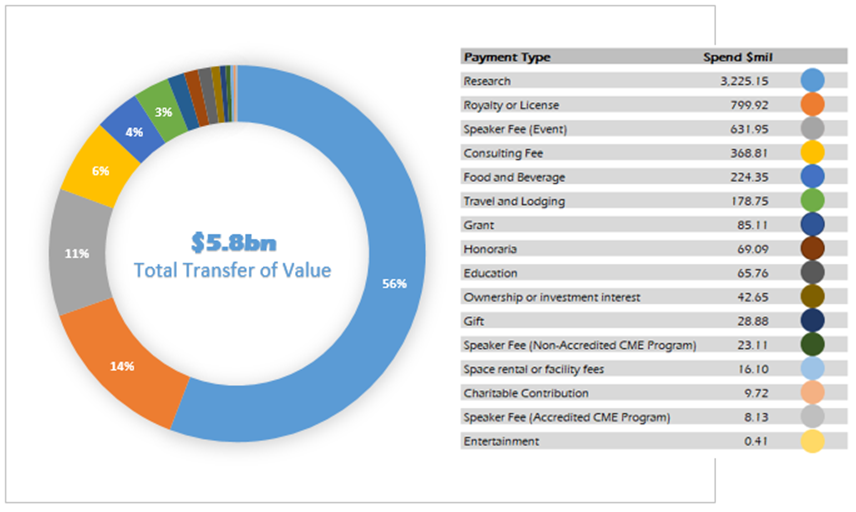
We used public data from CMS to perform a variety of exploratory data analyses — for the industry as well as for a specific corporation. Such analyses can present competitive advantage, offer unique opportunities for self-regulation and provide more business insight.
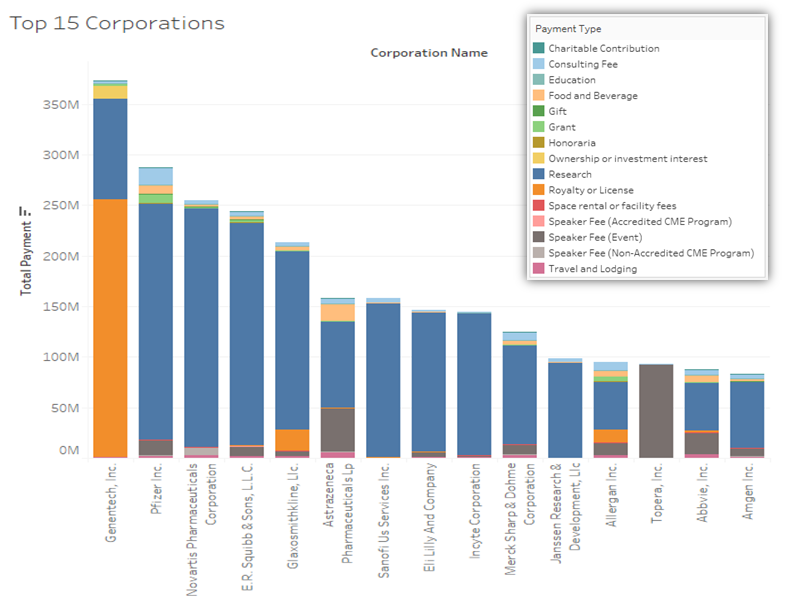
The quickest win is to find your competitive position in the industry — for instance, the top 15 pharma / medical-device corporations with the highest transfers of value.
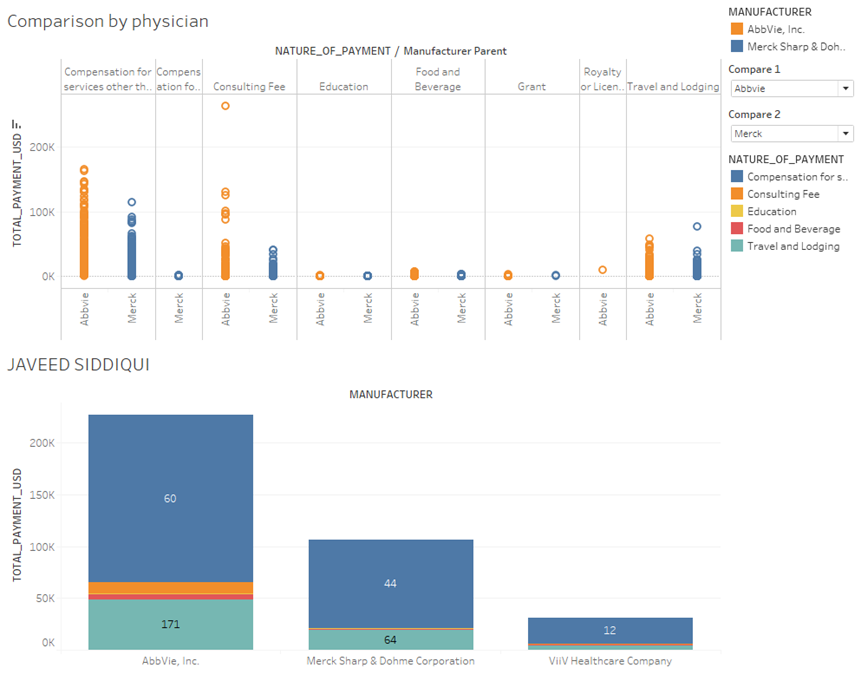
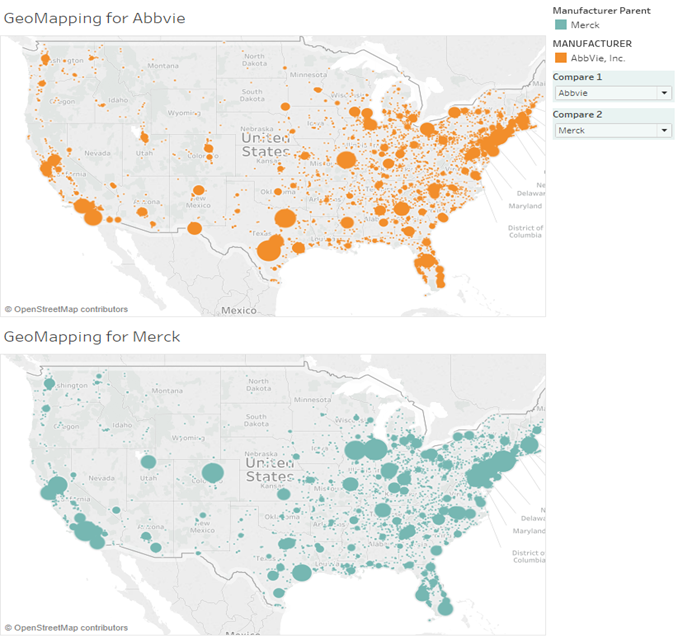
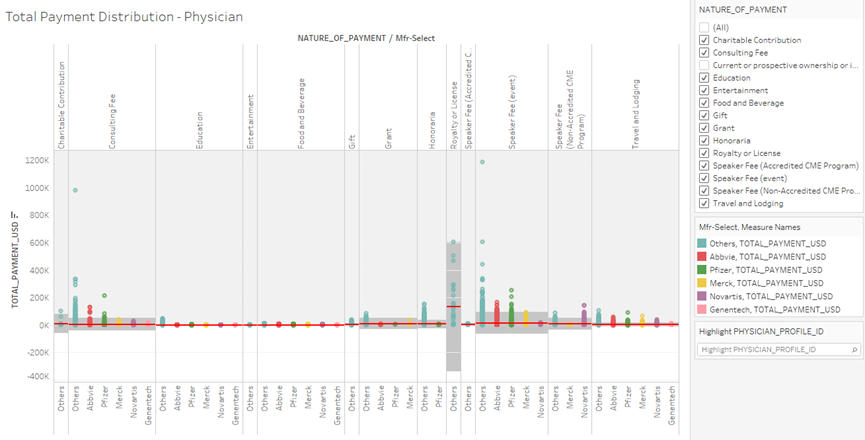
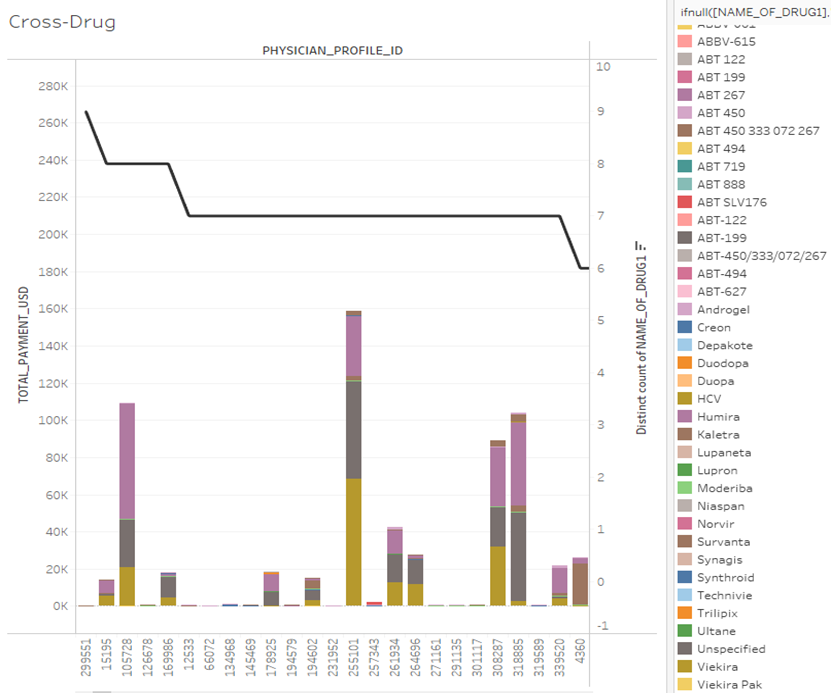
Find physician networks — HCPs interacting with your corporation as well as competitors, HCPs interacting only with competing drugs / devices, and influential HCPs within specialties. For instance, we compared spend between two prominent manufacturers, AbbVie and Merck, and by narrowing focus onto a significant physician were able to visualize his network of manufacturers.
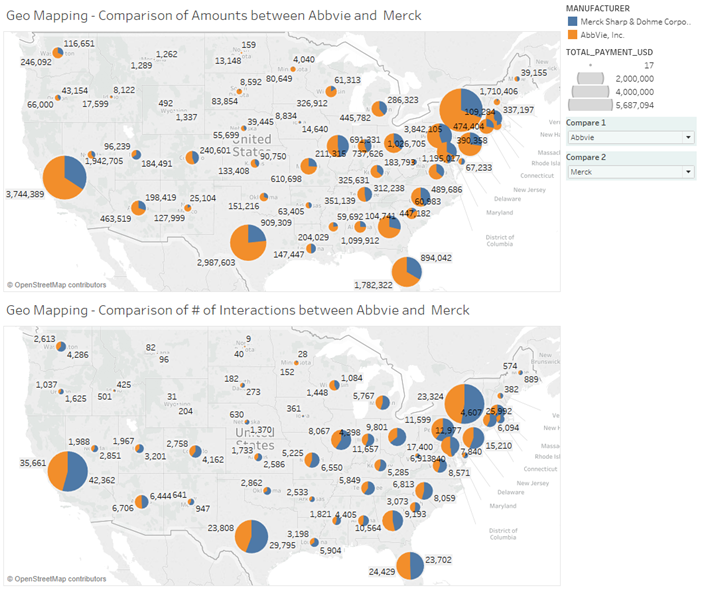
Geo-mapping the spend gave our client insights on competitive presence: Are HCP interactions clustered around field offices? Are there unexplored markets? Which regions are competition-heavy and might need more presence? Below we visualized number of interactions and total spend by state and ZIP code for the same two players.
Combine open-payments data with other public data like Medicare to determine cause and effect — is there a correlation between HCP spend and prescribing practices? Instances of low prescriptions despite high HCP spend create opportunities for feedback and information exchange.
We used open-payments data in conjunction with the client’s private data to examine internal processes around sales activity. We compared physicians with few interactions and high spend versus many interactions with low individual spend — observing HCPs with over 200 interactions a year for an average of $800 each, and others with two interactions a year for an average of over $100,000 each.
We combined CMS open-payments data with the client’s private data to find associations between sales reps and HCPs. Some findings: the same sales rep having a meal with the same HCP more than 50 times a year; the same HCP interacting with the client on the same day but in more than one city; and sales reps logging HCP interactions over 150 times a year, engaging as many as 500 HCPs.
Cross-drug spend: we noticed physicians receiving payments for as many as nine drugs from the same company. From an industry perspective, the top 5th percentile of physicians interacted with as many as 29 drugs in a given year.
To bring greater transparency to the relationship between the pharmaceutical / medical-device industries and physicians / hospitals, the Sunshine Act in the USA and the EFPIA Code in Europe require applicable manufacturers to disclose any Transfer of Value (TOV) made to physicians and hospitals. In the US, CMS published the first Open Payments dataset in 2014. 33 EU, EEA, EFTA and other EFPIA-member countries published their first disclosures on 30 June 2016.
Want to have an introductory discussion with our experts? We will be happy to have a call with you. Don’t worry, it is free!
Or want to test us out for a week at a heavily discounted price? Engage us — you won’t regret it!
Just leave us your details and we will contact you within 12 hours. We know your problem is urgent!
Or call us at 510 278 4083
email us at contact@neocortex.com